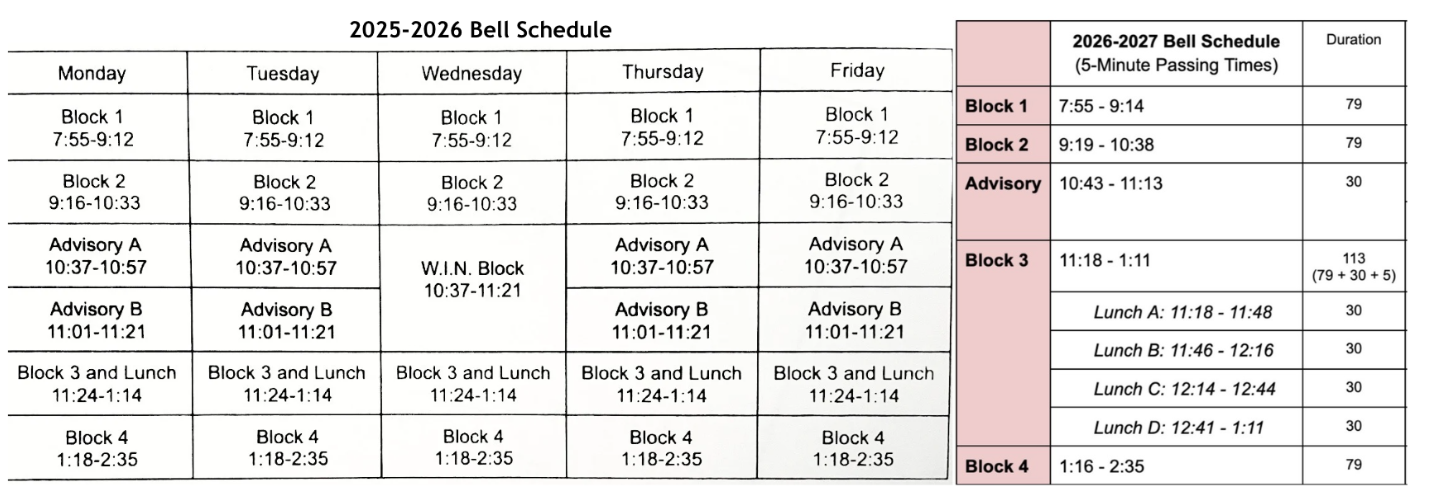
When a Bedford High School student misses school for just one day, they have to make up at least two classes from that day during the What I Need or “WIN” block. However, with only 30 minutes of WIN every Wednesday, it takes more effort coordinating time with teachers to catch up on one missed day. The only alternative is to fall behind, obviously a step back. Previously, advisories A and B gave free time for students to hang out with their friends who weren’t in the same classes as them. But now, they are replaced with a combined, shorter advisory. So, has this change of timing made it harder to manage time, or has it improved student productivity?
Advisory was built to create a close community of teachers to students that see each other everyday. These connections build supportive relationships and a place where students can discuss issues to their advisor and friends. Before the 2026-2027 school year, a 20-minute Advisory A was made for freshmen and sophomores to spend with their advisors, and another 20-minute Advisory B for juniors and seniors. During the additional advisory time that students and teachers were not required to be in, they had free time where they could be almost anywhere in the school doing a variety of activities. WIN and club blocks were also longer, at a total of 40 minutes.
WIN blocks every Wednesday have always functioned as unequivocally crucial time periods in a student’s weekly life, a period where one can make up classes and quizzes that were missed. Although many students have managed time that they can use to organize with teachers to make up assignments, some don’t, or the times simply don’t align, and the student still has to catch up as soon as possible. This decreased WIN time blocks causes students to struggle balancing their time, a leading cause of grade mismanagement, high stress, and other issues.
The old schedule gave both students and teachers a ‘mini WIN’ each day. Mr. Milne, a sophomore advisor and a math teacher, says that he prefers the old advisory better. He spent this free time “helping kids, planning, taking care of things [he] needed to take care of, and graded work”. From a teacher’s point of view, Advisory A and B was a more efficient use of time than a combined, 30-minute advisory. That said, he says that he understands how students who need to move between floors would use the additional minute in passing times.
Arnisa Zaloglu, a sophomore student who has experienced both systems, also recognizes that she got more stuff when she had Advisory B free, and that there is “less time to talk to teachers during WIN Wednesday”. Even so, since a majority of clubs previously took only 20 minutes of the club time, she prefers how the new schedule has given an overall longer time in these clubs.
Overall, the old system brings academia and relationships together in far more balance. So why lose what you already have? The old schedule is categorically better for school life so changing it provides nothing. With that I say: bring the old schedule back!






Comments are closed.