I often find much tranquility, sereneness, and peace in the woods near my home. I do not live in a remote region to be true to myself, but the nature here is in abundance. It is part of the reason for why I love hiking, camping and identifying nature so much. In particular, in the past two years I have become enthralled by identifying flora, aided by iNaturalist and countless local guides on distinguishing various species. Besides noting mentally what this and that species is, it delivers a note of conformity inside me – if I may recognize the other life forms that surround me, I may also push myself in the most difficult of moments. Thanks to this, I have also become a writer on behalf of commonsense environmental issues, a trail maintainer, and a more true lover of the world around us.
This morning was a wonderful day to go outside. After spending the first school days within walls, it was much more senile and appreciated to sleep till’ 9 in the morning. After waking up, I chose to go for a walk. Enjoy the photographs that I took along the walk, and do some more research about your local flora & fauna (and do not forget the fungi!). There is always more to learn and explore about the life near your home.

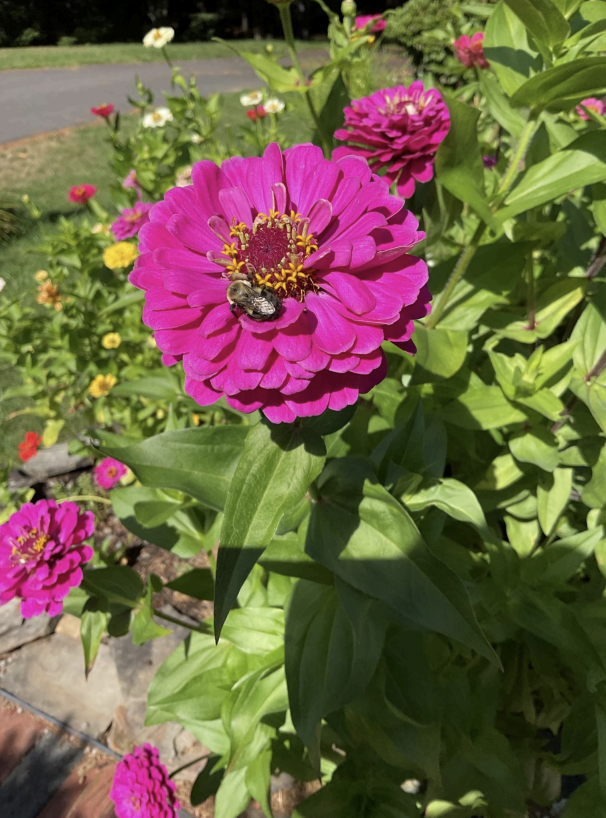
First thing this morning: A Common Eastern Bumble Bee feeding on a hybrid form of a dwarf zinnia (Genus Zinnia)
Along the way, I noticed some Eastern Hemlocks (Tsuga Canadensis), drooping their yellowing needles. There is no definitive answer for why this happens, although some are connecting these growing incidents to the Hemlock Woolly Adelgid, an invasive species that causes defoliation to many pure stands of Eastern Hemlock.


Lowbush Blueberries (Vaccinium angustifolium) can grow in a wide variety of locations, such as on a sloped hill. Often, they do not possess blueberries, such as shown here. However, species such as White Tailed Deer, Cardinals and Eastern Gray Squirrels rely on the food as a source of energy and survival.

Sweet Everlasting (Pseudognaphalium obtusifolium), is a wonderful native species that thrives in cool, shady and moist spots. It has a pleasant, delicate smell, and attracts bumble bees and local butterflies.

Fall is coming! Sugar Maples (Acer saccharum) are often one of the first trees to drop their leaves in the fall. Here, a nearby Sugar Maple has already done this to some leaves. In February, these trees possess the incredible ability to produce high quantities of sweet sap, which is later used to create maple syrup.

In southern New Hampshire, horseweed (Erigeron canadensis) is a common native plant that grows in sunny, exposed locations, such as near stone walls. It is often considered a nuisance to many farmers and lawn maintainers.

Yellow Toadflax (Linaria vulgaris) is an introduced species to the United States, coming from Europe during the colonization period. Since closed cultivation, it has spread throughout North America. Despite being non-native, it attracted bumble bees, moths and other pollinators, and is resistant to many diseases and herbicides.

A majestic Northern Red Oak (Quercus rubra) stands in the late morning sunlight. This may be the most common tree in southern New Hampshire.

Closer to the woods, a couple vines of Summer Grape (Vitis aestivalis) lie on the border of shade. From experience, this species does not usually produce any form of grapes, supplying most of its energy to growing its leaves and expanding.

A variant of Calendula has become naturalized into this grassy environment. Calendula is known to attract many native pollinators, and deter deer from consuming other domesticated plants (due to its bitter taste).

A little further down the road I stumbled upon a whole patch of Goldenrod (Genus Solidago), growing in the sun. Due to the many species and hybrids that this Genus is capable of, identification is very strenuous. Nonetheless, this species is an essential part of the local flora, hosting many local insects and pollinators and covering eroded, sandy soils.

In this lightly moist environment, a living specimen of Swamp Aster (Symphyotrichum puniceum) has found its home here. Often thriving in swamps, bogs, riversides and wetlands, despite the prolonged drought in this region, it is still hanging on.

Sweet Fern (Comptonia peregrina) on a rocky outcropping. This fern grows where other plants simply cannot, due to its ability to survive even with limited water resources.

An invasive Norway Maple (Acer platanoides) tree has become a host for tar spot, a fungal disease. Norway Maple has been prohibited by law from being sold within New Hampshire’s state boundaries, as a result of its fiery ability to spread through seeds.

Another Eastern Common Bumble Bee enjoys a morning snack on White Wood Aster (Eurybia divaricata).

Close to a massive pile of gravel (not shown in the photograph), Virginia Creeper (Parthenocissus quinquefolia) is getting ready for the fall with blazing red colors (also aided by dry conditions).
Unfortunately, many of these plants are under increased stress due to deforestation, new construction, climate changes, prolonged droughts, and invasive species. One way to help is by using less pesticides and herbicides to reduce the number of species being accidentally killed or reduced in numbers. And always remember to help out your local environmental group, organization, or agency if you can. We all can contribute to a healthier, better world.